unit 4 typography (2.1 describe the key elements of copyright laws affecting the use of typefaces)

Font piracy is rampant—and copyright protection isn’t an option—but don’t despair! Design patents are a viable way to safeguard your new typeface.

Type’s legal history is a frustrating story—especially for typeface creators. The U.S. is the only major industrialized nation that doesn’t protect font design through copyright law. This inability to use copyright law has forced the type industry to seek other means of legal protection, namely trademark and design patents. Although these options aren’t ideal, they can be used to protect type. Understanding type’s uneasy relationship with the scales of justice may help shed some light on what designers can do to protect their typeface designs.

Type’s Dismal Copyright History

On July 2, 1974, Eltra Corp. filed an application with the U.S. Copyright Office to register a copyright for the company’s ORION typeface. The Copyright Office rejected the application, finding that the typeface design contained “no elements, either alone or in combination, which can be separately identified as a ‘work of art.’” Eltra sued the Copyright Office and lost.

In 1976, while the Eltra case was still pending, U.S. copyright law was revised. The House of Representatives’ report contained bad news for type designers: “The Committee does not regard the design of typeface … to be copyrightable ‘pictorial, graphic or sculptural work’ within the meaning of the bill. …”

For more than 10 years, the answer to the question, “Is typeface design legally protected?” was essentially “no.” But the plot thickened when computers radically changed the way typeface designs are created. In 1988, the Copyright Office announced that the digitized representation of type designs can’t be registered because they don’t constitute original works of authorship—a basic requirement of copyright registration. Before, typefaces couldn’t be registered because they didn’t constitute original works of art separate from the utilitarian function of representing the alphabet. Now fonts were denied registration because they contained no creative authorship.

n its 1988 policy statement, the Copyright Office went one step further, making the distinction between the computer program that created the font and the actual typeface itself. A computer program, it said, could be registered even if the thing it creates could not. But in order to register such a program, the copyright application must specifically disclaim any copyright in the fonts created by the program. (Of course, if you’re using an off-the-shelf program like Adobe Fontographer, the software company already holds the copyright in the product.)

In 1992, the Copyright Office issued another policy statement reiterating its position that the computer programs used to create fonts were protected but the typefaces weren’t. The Office concluded, however, that the disclaimer requirement was “too burdensome” and announced that it was no longer required in type-program copyright applications.

Looking to Patents and Trademarks

When it became clear that copyright law offered no hope for protecting fonts, typeface creators turned to patent and trademark law. Because trademarks are available for the name of a typeface—but not for the design itself—trademark law offers minimal help for font designers.

Patent law is more promising. Design patents are available for ornamental designs embodied in a manufactured article. Although design patents are traditionally granted for industrial designs like furniture, hundreds of typeface design patents have been issued. While typeface patents can take a long time to come through, the process isn’t as difficult or expensive as the process for utility patents (for inventions). Designers were concerned, however, that the same problems of originality and creativity for copyrighting typefaces could affect the validity of design patents.

In 1995, Adobe Systems sued Southern Software, better known as Softkey, for copyright infringement of Adobe’s Fontmonger and Fontographer software when Softkey created a new font collection called Key Fonts Pro. Adobe claimed that Softkey began selling font packages that were essentially manipulations of typefaces included with the programs. Softkey argued that no creative authorship was involved in the creation of fonts, claiming that all it had really done was to manipulate an unprotected font image to create another slightly different (but still unprotected) font image.

Adobe also sued Softkey for infringing design patents Adobe had obtained on some of its fonts included in Fontographer and Fontmonger. Softkey claimed that design patents for typefaces were invalid because they didn’t meet the statutory requirements of originality and ornamentality in a manufactured article. This is a similar argument to what the Copyright Office claimed in its 1988 and 1992 policy statements. But Adobe prevailed and the lower court found that typefaces are appropriately covered by design patents.

Protecting Your Fonts

So where are we now? What should you do if you want to try to protect a typeface design? Some things are clear. You still can’t get copyright protection for the typeface itself, but you can secure protection for the computer program that creates fonts—if it’s an original program you created yourself.

You can obtain a design patent for a typeface as long as you meet patent requirements. But the Adobe/Softkey case is currently on appeal, leaving open the possibility that design patents and the copyrightability of font-creation computer programs could be in jeopardy.

And you always have the option of registering a trademark to protect the name of a typeface under which it’s being marketed, but not the typeface itself. Although a trademark registration for a font name may be appropriate in some situations, it doesn’t protect the actual font design. At the moment, it looks like a patent is the only viable legal path to protect type designs.

You can obtain design-patent protection for your typeface if it meets the following criteria:

  1. The typeface wasn’t generally known or accessible to the public for more than one year prior to filing your application. This means that if you or your client have been using a font that you designed for years, it won’t be eligible for patent protection; it has to be newly created.
  2. The font wasn’t used or described in a printed publication in any country at all during the year prior to filing. So even if it hasn’t been made public, it will still be ineligible if it appeared in print anywhere in the world.
  3. The face isn’t registered as a design patent or industrial design in a foreign country.
  4. The font must be completely new—it can’t be an obvious variation of another design.

Assuming your typeface meets all of these criteria, you can file for a design patent. It’s possible to file for a patent yourself, but it’s not a good idea. The filing and issue fees in the U.S. Patent and Trademark Office total $395 per patent. The process can take as long as a year and has many traps for the unwary, so consult a registered patent attorney.

What Can You Do?

Are any remedies available to you if your font is copied? Typeface piracy is so common that it’s almost expected. In the absence of an issued design-patent registration, there isn’t much that can be done. This lack of remedies is precisely why there’s so much consternation over the lack of copyright protection. With a registered design patent, you can sue for patent infringement and are entitled to actual damages and profits. Damages may be increased if the patent infringement is willful. Although you can be compensated for your legal fees if the judgment is in your favor, this isn’t automatic. If you haven’t received your patent registration yet or haven’t applied, you can’t sue for infringement.

The future of legal protection for typefaces doesn’t appear bright. The only realistic option is new federal legislation that would include typefaces as copyrightable subject matter. Because Congress considered the issue in 1976 and decided not to include typeface protection in the Copyright Act, it doesn’t look likely that the decision will be revised.

Type, although unprotected, is a vital part of works of design and art that are protected by U.S. law. Fonts can play a crucial role in the trademark or trade dress of a product or service and be protected for their ability to identify goods and services, if not for their design. (For example, the Coca-Cola typeface is a critical aspect of its name and logo. The typeface is protected because it is the logo.) The lack of legal protection for type shouldn’t dissuade creative development.


The right typeface is often the key to a great logo design, graphic or web design. But there’s much confusion and misinformation about typefaces, fonts and the law.

Many people do not understand the law governing the use of typefaces and fonts. Others incorrectly assume that they can freely use any typeface or font for logo fonts or any other design project.

When you purchase a commercial font, you are purchasing a license to use the font software. Your rights and obligations are defined in the End User License Agreement (EULA). Those agreements will vary among fonts and among font makers – so read them very carefully to understand what you can and cannot do with the fonts you’re licensing. For example, some agreements will restrict the number of computers on which you can install a font.

How is a font different from a typeface?

Technically, a “font” is a computer file or program (when used digitally) that informs your printer or display how a letter or character is supposed to be shown. A “typeface” is a set of letters, numbers and other symbols whose forms are related by repeating certain design elements that are consistently applied (sometimes called glyphs), used to compose text or other combination of characters.

Although many people would call “Helvetica” a font, it’s actually a typeface. The software that tells your display or printer to show a letter in “Helvetica” is the font.

What is copyright?

Copyright is a form of legal protection provided to those who create original works. Under the 1976 Copyright Act (United States), the copyright owner has the exclusive right to reproduce, adapt, distribute, publicly perform and publicly display the work. Any or all of these rights can be licensed, sold or donated to another party. One does not need to register a work with the U.S. Copyright Office for it to be automatically protected by copyright law (registration does have benefits – but we won’t be covering those in this article). For more about copyright law, you can read Everything Marketers Need to Know To Avoid Violating Copyright Lawand Small Business Legal Issues: Copyright Basics.

Does copyright law protect typefaces and fonts?

Generally, copyright law in the U.S. does not protect typefaces. Fonts may be protected as long as the font qualifies as computer software or a program (and in fact, most fonts are programs or software). Bitmapped fonts are considered to be computerized representations of a typeface (and are not protected by copyright law). On the other hand, scalable fonts (because they are incorporated as part of a program or software) are protected by copyright.

This means that copyright law (at least in the U.S.) protects only the font software, not the artistic design of the typeface.

You should remember that copyright law, and more specifically, as it relates to typefaces and fonts, varies by country. For example, the U.S. may be the only country in the western world not to recognize intellectual property rights in typeface design. The U.S. Copyright Office has unequivocally determined that fonts are not subject to protection as artistic works under the 1976 Copyright Act.

In contrast, Germany recognized in 1981 that typeface designs can be protected by copyright as original works. England also allows typeface designs to be protected by copyright (since 1989).

Doesn’t the U.S. have to follow the copyright law of other countries under international treaties?

Yes and No. All of the major copyright treaties and agreements to which the U.S. is a party (such as the Berne Convention) operate under a common principle (called “national treatment”) which holds that a country must treat foreigners and locals equally. That means, among other things, that the U.S. is not obligated to provide greater protection to works from other countries than it provides to works produced in the U.S.

Does this mean you can copy typefaces without worrying about copyright law?

Some argue that you can copy a font (by recreating it yourself) and as long as you don’t copy the computer program, you’re not violating the law (in the U.S.). How might you do this? Among other ways, you can lawfully print every glyph on a printer, scan the image and then trace each image on your computer (none of this would involve copying the software or program representing the fonts).

This gets a bit muddied when you consider that fonts are often tweaked and used as part of a larger design. For example, a typeface may be customized and used as part of a logo design. While the typeface itself is not subject to copyright protection in the U.S. (even if the company name is otherwise trademarked), the logo design itself might be protected as an artistic piece, taking into account the arrangement of letters, use of space, organizations, colors, and other creative aspects of the design. A good example of this is the Coca Cola typeface – the typeface is protected because it is the logo.

Does patent law protect typefaces?

Sometimes. Typeface designs can be patented but typically are not. Moreover, even those typeface designs that have been patented were patented some time ago and nearly all of the design patents have expired.

Does trademark law protect typefaces?

Trademark law protects only the name of a typeface, but not the design of the typeface.

Can you use “free” fonts without worrying about the law?

Maybe. Although many free fonts allow unrestricted use (including use for commercial projects and as logotype fonts), “free” fonts can sometimes be fonts that are illegally copied. Be careful and make sure that the fonts you are using come from a trusted source and that you understand your rights and obligations.

Can you license a font to a client?

Typically, your right to sub-license a font is governed by the EULA. You cannot send the client a font unless the EULA specifically permits you to do so. This means that if the client will need the font, they will be required to purchase a license to use it.

Most logo designers avoid problems related to font licensing by converting their logotype to outlines (in a program like Adobe Illustrator) and sending the client a vectorized outline (but not the font).

Three Questions To Ask When Using Fonts In Your Designs

1. Are you legally allowed to use the font? Many fonts are sold commercially and cannot be used by people who do not purchase those fonts from proper vendors.

2. Is your intended use permissible? Some font licensing agreements may restrict ways that you can use the font. Review the agreements carefully when in doubt.

3. Can you sell and/or send a copy of the font to your client? Typically, at least for commercial fonts, the answer is NO. Your client will be required to purchase the font. One way to avoid this is to outline the font (as described above) and provide the client a vectorized outline.

Unit 4 Typography (1.1 research typographic characteristics and techniques)

1. Font Weight

The font weight is often the first thing we notice. The main types of font weight are light, regular, and bold. Regular font styles are neutral; they are least affected by optical distortion or poor sharpness. They have the most readable grapheme, which is why regular weight is perfect for reading. Light and bold font styles are more expressive as they convey a whole range of emotions, from delicacy to perhaps even rudeness.

Thin, Regular, Black styles of Kazimir Text typeface.

Thin or light font styles are pleasant to look at as a linear drawing. A phrase in such font wouldn’t catch your attention (unless you want it to); it can be “switched off” just by shifting your glance. Hence it carries the connotation of sensitivity and care. It comes as no surprise that such font styles are widespread in cosmetic field and in everything that is close to the body; from undergarments to wearable gadgets.

Semibold font styles contain maximum uniqueness of shape, retain readability and add value to the text. Due to this they are used for emphasis in the text, as well as in logos.

Bold font styles are designed to draw attention to short phrases. They are not very easy to read, but you have no choice. Once you spend enough time looking at such font, your brain becomes familiar with it and adapts.

Black fonts create a feeling of heaviness, power and enhance the existing properties of the font, which are impossible to convey with more neutral styles that lack the weight. Such font styles provoke a quick emotional response, that’s why they are often used in games, advertising, and show business.

2. Font Width

Width of the font characters, just as their weight, is quickly recognized and strongly affects readability and visibility of a piece of writing. Regular width font styles are preferable for reading, while other variants — condensed and extended — are very specific and have distinct emotional associations.

Extra condensed font — Reforma Grotesk Medium, regular width font — Pragmatica Book, extra extended font — Europe Extended.

Slightly condensed font styles can also be readable. Compact versions of text fonts are used when you need to fit lots of text into a small space. But this technique creates a slight feeling of tightness and seems like you’re trying to save up space.

Extra condensed font styles have more interesting characteristics. They are easy to notice due to vertical lines that begin to prevail in the text. It looks like someone tall has climbed onto a stand and is firing up the crowd. Due to low readability of narrow letters, this font can convey only short words that are really important. Therefore, extra condensed fonts naturally look better where a “stop effect” is needed: in advertisements and headlines.

Extended and extra extended font styles greatly change the perception of a text. In extended fonts, character shape changes, more horizontals appear. Even a short word is now read slower; it becomes significant and memorable. Everything around the text looks abundant and impressive. Extended font styles are well readable at an angle — the perspective compensates proportions. That’s why such fonts are often used by manufacturers of cars, airplanes, and sporting goods.

3. Font Contrast

The difference between the main and additional strokes is called font contrast. Contrast defines a font’s position on a legibility/appearance scale. Low and medium contrast is helpful during long reads and doesn’t always evoke a special mood; in return, extreme values — monoweight and high contrast — create distinct imagery.

Monoweight font — Stem, medium contrast font — PT Serif, the highest contrast — DietDidot.

Without any contrast, the text looks simple and neat, sometimes even primitive. Monoweight fonts break a bond between typesetting and handwriting, resting upon industrial and postindustrial urban aesthetics in all of its aspects, from stick fonts to neon signs. These qualities make monoweight fonts a perfect solution for those who want to look modern and forward-thinking.

Extra high contrast is an artistic characteristic of Romanticism and Classicism fonts. Contrast fonts sacrifice readability to the beauty of a title sheet, cover art or poster. Interchanging thick and thin lines are reminiscent of dramatic confrontation between strength and weakness, ice and fire; and connection of contrast strokes creates an elegant silhouette and a rhythm, which reminds one of music or dancing. It’s logical that contrast fonts are perfect for theater, fashion and glamour.

4. X-height

The height of the lowercase letters against capital letters and their own ascenders or descenders is one of the main font properties that define its usage. Mood and character of the message depend on X-height.

Small x-height — Metropol font, medium x-height — Orbi Sans font, large x-height — Hermes font.

In case of medium X-height (from 2/3 to 3/4), upper-case and lower-case letters keep balance of similarity and difference, which allows to easily find the beginning of a sentence, but doesn’t distract you from reading. This moderation, along with the other characteristics, makes the font easy to work with in text.

Small X-heights (1/2 and less) create a significant difference between letters within one font. They make the font twice as diverse and interesting as the equivalent font with medium X-height. The more the difference, the better you can communicate extroversion, musicality, and artistry. These qualities make it perfectly suitable for short personal or lyrical texts: poems, greetings, invitations, and playbills.

Large lowercase letters (more than 3/4) make the font more homogeneous (upper-case and lower-case letters look alike); using such font allows you to fit more text in the lines. Due to smaller capital letters and short ascenders and descenders, there’s little interaction between text lines and space. These are introvert fonts that communicate a feeling of stability and safety, but sometimes lack a friendly vibe.

5. Corner Rounding

Intersections and connections of strokes inevitably form corners. Square corners like in THE, or sharp ones like in AVZN. The end of any stroke also has its own outline: sharp, square or rounded. Corners, intersections, and edges are natural visual irritants. Usually, people notice each corner and focus; without this skill, our ancestors would run into sharp stones and branches. So, the sharper the corners in an inscription, the easier it catches the attention of the viewer.

Sharp corners — Acsioma font, square corners — TT Souses font, rounded corners — Sans Rounded font.

Substitution of common, expected corners with round ones decreases eye strain and is associated with smooth, nice to the touch surfaces. This evokes pleasant emotions and feeling of comfort. Rounded letters also work with our primary instincts, as a round shape is the basis of baby shape. That’s why bold and rounded fonts are so good for baby food, shampoos, and diapers. Also, when paired with something hand made, it makes the font look like food — buns, ice-cream, fruits.

Sharp corners and stroke edges draw greater attention, create tension, and even discomfort. But they can be really useful if you sell “thrills”, and want to surprise or shock your audience. That’s why “prickly” fonts are common in goods for teenagers, attributes of heavy metal and other subcultures.

6. Serifs and Slabs

Font serifs is the most important characteristic in any font classification. Serif shape depends on the overall logic of font building, and this logic has been developing from the Ancient Rome to present day. Due to ancient origins, fonts with serifs are called Antiquas. You appreciate serif fonts like you appreciate good wine and there are heaps of books on this subject, but here we will speak about what their overall meaning and their proper uses are.

Concave serifs — Lazurski font, linear serifs — Petersburg font, slab serifs — Pragmatica Slabserif font.

In text fonts like Times New Roman, serifs at the ends of strokes help the eye to move faster along the line of text. Even in case of low sharpness, serif doesn’t allow optical distortion to shorten the vertical stroke, so the baseline and letter height are preserved. For this reason serif fonts are typically used in large literary, scientific, or educational texts.

On a large scale, Serif fonts become a historical costume on a character taking the viewer to the right place and time. Venetian SerifGaraldesEnglish serifClassicist serif — all of them are portals to their country and historical era. The higher the level of cultural sophistication of a viewer, the more precisely he or she will travel. Even a mass consumer that is not familiar with these things or history would decide that it is a classical, historical font that he or she sees, and these associations evoke trust. All serif fonts, except slab serifs, to a greater or lesser extent communicate pathos of their Great ancestor — Roman square capitals from Trajan’s Column. This is an understanding that is a known fact with Hollywood producers, which is why Trajan is the most common typeface in cinema.

Trajan font in cinema

Slab serifs greatly differ from other serif shapes, so slab serif fonts have their own place among the classifications. A serif is considered to be a slab when it’s straight enough, rectangular and comparable in thickness to the main font stroke. It’s very inconvenient to write such letters with calligraphic tools; it’s better to draw, stamp, or cut them out. Such form doesn’t contribute to comfortable reading, but instead it can carry the viewer to different places, from the Wild West to 1930s Germany. The main feature of slab serif fonts is their patriarchal severity, that’s why they look so natural at factory floors, hand tool shops or steak houses.

7. Italics and oblique

Italic and oblique font styles are common in modern font families in addition to straight ones. However, they have different functions and meaning.

Italic font style — Kudryashev Italic, oblique font style — Pragmatica Italic.

Italic font styles differs from regular by a more handwritten form, because they originated from common Italian handwriting of the Renaissance era. From the 16th century till present day, italic is used to highlight text. The slant implies a change of intonation when reading. In addition to this, handwritten letter shapes have less vertical lines and more elegant curves, which add a pleasant polite tone to a phrase. Everything that is reminiscent of handwriting seems to be more personal and confiding, than direct “printed” letters; for this reason most greetings and invitations feature handwritten fonts or italic serif styles close to cursive.

Oblique font styles are built by means of slanting upright letters and mainly serve to communicate the feeling of speed to a text, and sometimes, to highlight parts of it. After slanting, all vertical lines become oblique, and even rounded shapes lose part of their uniqueness. More monotonous text, as if leaning due to wind, is perceived as something speedy and prompt. That’s why slanted fonts are an excellent choice for sport or an automobile theme.

8. Geometry

In digital fonts, every letter is built according to a geometric formula. But this formula has different meanings for function and character of a font. In decorative typefaces that imitate handwriting (blots, and paint brush strokes), geometry is rejected, and their form is sort of spontaneous. But the most part of general-purpose fonts created since the invention of book-printing till nowadays are well calibrated and have either humanistic or geometric proportions.

Humanist construction means that it is based on a form of handwriting of Renaissance Age humanists, thus the name. These are beautiful and legible fonts, designed to perfection. They have open varying-width letters with distinct difference between upper-case and lower-case letters with slanted stress axis. In humanist typefaces, geometry serves for shape perfection and doesn’t create specific images. They are convenient for most people and are practically universal. For this reason Sans Serif typefaces with humanist proportions are common in public communications; for example in urban wayfinding.

Humanist sans — Leksa Sans, geometric sans — Futura PT, modular font — Robotesqa 4f.

Geometrical design from scratch, despite experience and tradition, is characteristic of the 20th century. The first geometric fonts appeared in 1920–1930s under the influence of Constructivism. All characters were built of simple geometric shapes: circle, square, triangle. Typically, they were sans fonts or the serifs were replaced by slabs. Nowadays, they are called Geometric Sans Serifs and Geometric Slab Serifs.

Ideas of scientific progress, standardization, simplification led to the creation of a new type form. A simple drawing is able to totally replace handwritten and typefoundry heritage, and even common letter outlines (graphemes) can change. For instance, the round letters ОСD can become square, and the whole font can be built of the unified modules. At that, the letter shape would lose its influence on readability and image. Everything will depend on the module shape: a bow, a polygon, a square. For example, modular fonts of Star Wars, Terminator, and Robocop era use their not-made-by-hands form to illustrate fantastic future with all its space flights, smart machines, and other technologies that have excited people since mid-20th century.

The choice of a geometric font works like a time machine. You can take a viewer to revolutionary Russia (rectangles, sticks, triangles), pre-war Germany (rectangles, circles, bows), the jazz age America (triangles, circles, thin lines), or to the beginning of the computer age (squared letters, pixels, matrices).

Geometric Sans Serifs in modern logos

Geometric Sans Serifs are relevant today too — look at the 2015 Google logo for example. Font culture of 2010s re-appeals to a modernist style and reinterprets it. We’re seeing a return of the trendy geometric fonts, which due to high display resolution and smoothness of paper look perfectly precise, neat, and still readable. Such fonts perfectly solve tasks of global corporations, mass media, and even major politics.

9. Statics and dynamics

The letter shape of the font can be static or dynamic. The more there are horizontal and vertical lines in a text line, the more static the font looks. While lines and bows that are not parallel to the text line add dynamics to a font. Dynamics are affected by the following: stress axis slant in letters oecpbd, slope of bar of е, stroke endings of letters sca, and serifs shape. All these elements can be vertical, diagonal, or curved. Italic or oblique font styles make the drawing even more dynamic.

Static typeface — Din PT, dynamic typeface — Venetian, maximum dynamics — Liana font.

Static in a font comes off as a hallmark of calm and orderliness. It’s no coincidence that Helvetica (designed to be all-purpose neutral font) is static. But if the font has more verticals than usual, for example, due to squaring ovals, it will be associated with strict order driven to automation. This is perfect for restricted access facilities: precise manufacturing, railroad, power plants.

Dynamic pattern in a straight typeface (not so obvious as in italics) is a pleasant to notice nuance. This non-mandatory characteristic creates interest in a line of text. Its hidden complexity is the sign of true art. That’s the reason why dynamic fonts are good for everything aesthetic and creative.

10. Openness of letters

Open letters, like c, can be wide open, moderately open or almost closed. Openness of letters (aperture) affects the shape of characters: caes. Wide open letters are more compact than closed ones; their width affects font capacity to a great extent. Frequency analysis of languages shows that letters easc amount to over 30% of English. So, due to larger aperture and slight squaring of oval elements opdbq you can get very compact font, which won’t look tight and will keep good readability (like PT Sans, for example).

Open typeface — PT Sans, moderate aperture — Textbook New typeface, closed aperture — Helvetica typeface.

Moderate aperture doesn’t create mood by itself. Instead, half-closed letters are the most legible for fast reading, for example on road signs or license plates.

Wide open fonts show personality when working with short texts. They really have an open-to-the-world, extroverted nature. Their openness evokes a feeling of comfort, ease and honest communication. Such fonts are widely met in election campaigns of those politicians who promote ideas of freedom and democracy, as well as in advertising of something handy, comfortable, and elegant (like a smart home or a slim laptop).

The characteristics of closed fonts also conforms to aperture. These self-sufficing introverts induce a feeling of stability, reliability, and security. For this reason they are used in politics by conservatives and protectionists, and in advertising they are irreplaceable for everything based on security and protection.

Summary

Each font characteristic affects a person on the level of optics, ancient instincts, and cultural experiences. These hidden messages help your design work, but they can also hinder, so your font choice should be related to a message communicated, brand values, or preferences of your target audience. It’s better to use minimum of properties, adjusting them as precisely as possible rather than missing the target completely with too many adjustments. Then your design will be understandable to target audience, useful for the clients, and interesting for other designers.

If we gather all font properties in one list, we’ll get something like a menu in a Dutch pub:

  1. Weight affects the level of insistence: from tender delicacy (Thin) to persistent rudeness (Black).
  2. Width affects message urgency: from a screaming headline (Extra Condensed) to long-awaited appearance above the horizon (Extra Expanded).
  3. Contrast levels the artistry of a message: from a speech synthesizer (Monoweight) to Grand Opera actress (Extra high contrast).
  4. X-height is associated with a wish to impress the viewer: from a love letter (small x-heights) to indifferent “Break” sign (large x-heights).
  5. Corner rounding influences over tenderness level: from sleeping babies (Rounding) to noisy teenagers (Sharpening).
  6. Serifs and Slabs create cultural context: from idealism of timeless classics (Serifs) to pragmatism of factory stamping (Slab serifs.)
  7. Italic and Oblique ask for a moment of attention: to make a polite comment (Italic) or to communicate an urgent message (Oblique).
  8. Geometry reflects life values: from respect to a person’s peculiarities (Humanist fonts) to admiration of futuristic machines (Geometric and Modular fonts.)
  9. Statics and dynamics show individuality and richness of inner world: from neutral Helvetica (Static pattern) to Old Style Serifs, embodying pathos of their time and country (Dynamic pattern).
  10. Aperture affects sociability and progressiveness: from liberal extrovert (Open fonts) to conservative defender of borders (Closed fonts).

typography in branding

The Importance of Typography in Branding


As well as the use of colour in branding, the choice of font is equally important. It is yet another form of non-verbal messaging you are sending out about your brand. Your typographic palette helps to tie all communications together, from the copy on your website, direct mail through to your logo; creating brand consistency and memorability.

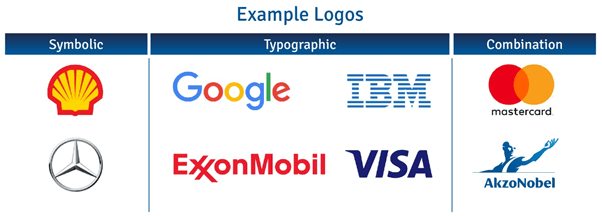
Logos can be divided into three broad yet distinct categories based on the design features used:

  1. Symbolic logos. Think of brands such as Shell, Mercedes
  2. Purely typographic logos, for example: Google, IBM, ExxonMobil, Visa etc
  3. A combination of both ie MasterCard, AkzoNobel

Typography in Branding - logo examples

The fact that large corporations simply use typography alone in their logos highlights the impact fonts can have, not having to be used in conjunction with any added symbol or graphic. Instead, the focus is on the form of the letters, the spacing and size. In addition to revealing your company name each of these design elements portray your brand identity and purpose to the target audience in a simple yet memorable way.

A word-mark or font-based logo is most effective when your company name is short, clear and self-explanatory. Referring back to the colour wheel shown in the blog post ‘The Importance of Colour in Branding’, there is only one single use of a symbolic logo, and only 10% are type-only. This is potentially because many of the company names listed are complex or use initials which does not make it instantly obvious what services they offer. This isn’t to say type-only logos are less effective, it is just important to consider what will work best for your brand. Many of these companies have opted to use combination logos to single out the brand among its competitors. In an undifferentiated market this is definitely a wise choice. That said, however, on further observation, there is a lack of differentiation between the type of fonts used. A vast majority have opted for sans serif fonts with only 2% adopting a classic serif font.

In order to understand this a bit more, below is a breakdown of 4 common categories available and their uses:

Serif

Typography in Branding - Serif font example

Examples: Times New Roman, Georgia

These are basic typefaces with serifs ie extra detailing sometimes called tags or flags. They are the oldest known typeface and therefore more traditional, portraying characteristics such as reliability, being dependable and respectable.

Sans serif

Typography in Branding - Sans-Serif font example

Examples: Helvetica, Arial, Trebuchet

Sans literally means without, so the characters are without the tags. They are neutral and contemporary used to depict simplicity.

Script

Typography in Branding - Script font example

Examples: Alex brush, Lobster, Pacifico

Script fonts often look handwritten used to express feeling and creativity. The more curvy and delicate the script font, the more it portrays femininity.

Modern

Typography in Branding - Modern font example

Examples: Bodoni, Didot

Popular in the 18th and 19th Century these classic fonts are elegant and distinctive representing smartness and intelligence. They are structured and eye catching with by extreme line weight contrast with vertical stress horizontal serifs.

Whilst colours have meanings associated with them, fonts have these personalities, making them a valuable tool to communicate the personification or your brand. However, in order for them capture your brand essence correctly, it is important to understand the font categories, their characteristics and the demographics of your target audience; and not simply pick them because they are just your ‘type’.


Brand Typography

Typefaces embody stories which can enhance your brand.
  • Brand Typography
Typefaces may vary, but whenever typography plays an important role in a brand identity, we can assume that the brand is appealing to a reader—someone who appreciates prose, or at least a good headline. They might be a comic book reader as much as a Shakespearean scholar, but, nonetheless, we expect them to read.

Monograms and Word Marks

Monograms and word marks rely on words (typically the initials or name of the organisation) rather than pictures to represent an organisation graphically, although lots of typographic games blur this line. Context and circumstances should guide decisions about whether or not to use a typographic logo.

When the goal is a mark that’s clear and straight-forward, type may be best. Of course, that goes out the window if the competitors have all done the same thing. See? Context.

For most organisations, word marks or monograms don’t ask the viewer to interpret much. That’s not true for organisations with unusual names. The Google word mark challenges customers on a different level than the word mark for Heath Ceramics.

A typographic logo opens up more possibilities than an illustrative symbol. And it’s closing fewer doors around the globe for U.S. companies as English has established itself as the language of international business. In a world that’s rapidly filling up with symbols (Don’t believe it? Check out your computer desktop), a word mark can look very clean, professional, and classic.

Monograms and Word Marks
Monograms can be inspired by a traditional monogram, varsity letter, or family crest. Word marks that employ straight type express the character of a brand in subtle ways.

Type Choices

Type has personality. Show us someone who disagrees, and we’ll show you someone who’s the walking embodiment of Times New Roman. Picking the right typeface means picking one that imbues your program with the right feeling. The choice begins with serif vs. sans serif.

The thicks and thins of serif typefaces evolved from the pressure points created by a calligrapher’s hand. Given that lineage, serif typefaces often get equated with tradition. By contrast, the relatively younger sans serif typefaces get equated with modernity. However, evidence hints that these personalities are in flux. Sans serif typefaces have been adopted for signage systems all over the world. As a result, what was once seen as quintessentially modern now can be seen as institutional.

Type Choices
All programs require choices about type. Some programs lead with type when establishing a brand image.

Personality is an important consideration when selecting a typeface, but it should not be the only consideration. Legibility, flexibility, and consistency are also important factors to consider for an identity program.

Type and Meaning

As with imagery, typography usually suggests an alternate meaning or cultural context for a brand identity. A type-style that references classic print ads from the 1950s pushes a brand identity in a very different direction than one inspired by graffiti tags on New York City subway trains from the 1980s.

Type-styles always carry their own history, which often shades the meaning of what is being written. Brand identities built with typographic elements in concert with images may ask a bit more of the viewer than those built with images alone, but they often create deeper and more lasting memories. Some of the most effective campaigns and promotions rely on a headline and an image working together as a single unit. That’s why advertising firms continue to partner writers with designers.


type of typography

Type Classifications

Most typefaces can be classified into one of four basic groups: those with serifs, those without serifs, scripts and decorative styles. Over the years, typographers and scholars of typography have devised various systems to more definitively categorize typefaces – some of these systems have scores of sub-categories.

A classification system can be helpful in identifying, choosing and combining typefaces. While four categories are clearly inadequate for design professionals, dozens become self-defeating. We have put together a somewhat hybrid system of 15 styles, based on the historical and descriptive nomenclature first published in 1954 as the Vox system – and still widely accepted as a standard today.

Classifications

Serif Type Styles

  • Old Style
  • Transitional
  • Neoclassical & Didone
  • Slab
  • Clarendon
  • Glyphic
Sans Serif Type Styles

  • Grotesque
  • Square
  • Humanistic
  • Geometric
Script Type Styles

  • Formal
  • Casual
  • Calligraphic
  • Blackletter & Lombardic
Decorative

  • Grunge
  • Psychedelic
  • Graffiti

Serif Type Styles

Old Style
This category includes the first Roman types, originally created between the late 15th and mid 18th centuries, as well as typefaces patterned after those designed in this earlier period. The axis of curved strokes is normally inclined to the left in these designs, so that weight stress is at approximately 8:00 and 2:00 o’clock. The contrast in character stroke weight is not dramatic, and hairlines tend to be on the heavy side. Serifs are almost always bracketed in old style designs and head serifs are often angled. Some versions, like the earlier Venetian old style designs, are distinguished by the diagonal cross stroke of the lowercase e.

Old Style Serifs

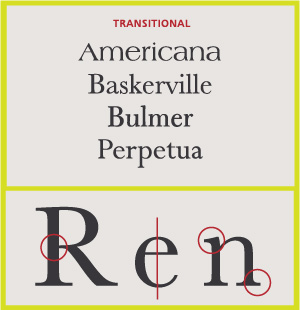
Transitional Serifs
English printer and typographer John Baskerville established this style in the mid 18th century. These typefaces represent the transition between old style and neoclassical designs, and incorporate some characteristics of each. Baskerville’s work with calendered paper and improved printing methods (both developed by him) allowed much finer character strokes to be reproduced and subtler character shapes to be maintained. While the axis of curve strokes can be inclined in transitional designs, the strokes normally have a vertical stress. Weight contrast is more pronounced than in old style designs. Serifs are still bracketed and head serifs are oblique.

Transitional Serifs

Neoclassical & Didone Serifs
These are typefaces created within the late 18th century, or their direct descendants. The work of Giambattista Bodoni epitomizes this style of type. When first released, these typefaces were called “classical” designs. Early on, however, it became apparent to printers that these were not updated versions of classic type styles, but altogether new designs. As a result their classification name was changed to “modern.” Since the mid 20th century, they have also been classified as neoclassical or didone. Contrast between thick and thin strokes is abrupt and dramatic. The axis of curved strokes is vertical, with little or no bracketing. In many cases, stroke terminals are “ball” shapes rather than an evocation of a broad pen effect. These tend to be highly mannered designs, with clearly constructed letters.

Neoclassic & Didone Serifs

Slab Serifs
Slab serif typefaces became popular in the 19th century for advertising display. These typefaces have very heavy serifs with minimal or no bracketing. Generally, changes in stroke weight are imperceptible. To many readers, slab serif type styles look like sans serif designs with the simple addition of heavy (stroke weight) serifs.

Slab Serifs

Clarendon Serifs
This category includes the typefaces patterned after the Clarendon type styles first released in the mid 19th century. Clarendons were designed as bold faces to accompany text composition. Their stroke contrast is slight, and serifs tend to be short to medium length. Later, many of these designs were released at larger point sizes as display types. Character stroke weight that is more obvious, and serifs that tend to be longer than earlier designs, mark more current interpretations of this style.

Clarendon Serifs

Glyphic Serifs
Typefaces in this category tend to emulate lapidary inscriptions rather than pen-drawn text. Contrast in stroke weight is usually at a minimum, and the axis of curved strokes tends to be vertical. The distinguishing feature of these typefaces is the triangular-shaped serif design, or a flaring of the character strokes where they terminate. In some type classification systems this category is sub-divided into two groups: “glyphic” and “latin.” “Latins” are faces with strictly triangular-shaped serifs.

Glyphic Serifs

Sans Serif Type Styles

Grotesque Sans Serif
These are the first commercially popular sans serif typefaces. Contrast in stroke weight is most apparent in these styles, there is a slight “squared” quality to many of the curves, and several designs have the “bowl and loop” lowercase g common to Roman types. In some cases the R has a curled leg, and the G usually has a spur. This category also includes more modern, sans serif designs patterned after the first grotesques. Stroke contrast is less pronounced than earlier designs, and much of the “squareness” in curved strokes has been rounded. Normally the most obvious distinguishing characteristic of these faces is their single bowl g and more monotone weight stress.

Grotesque Sans Serifs

Square Sans Serif
These designs are generally based on grotesque character traits and proportions, but have a definite and, in some instances, dramatic squaring of normally curved strokes. They usually have more latitude in character spacing than their sans serif cousins, and tend to be limited to display designs.

Square Sans Serifs

Geometric Sans Serif
Simple geometric shapes influence the construction of these typefaces. Strokes have the appearance of being strict monolines and character shapes are made up of geometric forms. Geometric sans tend to be less readable than grotesques.

Geometric Sans Serifs

Humanistic Sans Serif
These are based on the proportions of Roman inscriptional letters. Frequently, contrast in stroke weight is readily apparent. Typographic experts claim that these are the most legible and most easily read of the sans serif typefaces. Humanistic sans serif typefaces also closely match the design characteristics and proportions of serif types, often with a strong calligraphic influence.

Humanistic Sans Serifs

Script Type Styles

Formal Scripts
These typefaces are derived from 17th century formal writing styles. Many characters have strokes that join them to other letters.

Formal Scripts

Calligraphic Scripts
These scripts mimic calligraphic writing. They can be connecting or non-connecting in design. Many appear to have been written with a flat-tipped writing instrument.

Calligraphic Scripts

Blackletter & Lombardic Scripts
These typefaces are patterned on manuscript lettering prior to the invention of movable type.

Blackletter & Lombardic Scripts

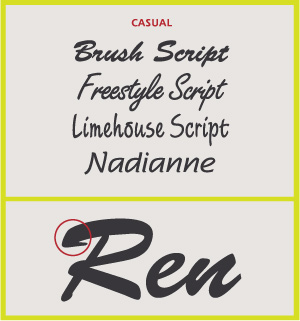
Casual Scripts
These typefaces are designed to suggest informality, as if they were written quickly. Many times they appear to have been drawn with a brush. Normally, character strokes connect one letter to the next.

Casual Scripts

Decorative Styles
This is the largest category and also the most diverse. Rarely used for lengthy blocks of text, decorative typefaces are popular for signage, headlines and similar situations were a strong typographic statement is desired. They frequently reflect an aspect of culture – such as tattoos or graffiti – or evoke a particular state of mind, time period or theme. Many – such as psychedelic or grunge designs – are time-sensitive and fall out of fashion. Some decorative typefaces use unorthodox letter shapes and proportions to achieve distinctive and dramatic results. Some even appear three-dimensional.

Decorative Type Styles

WHY IS BRANDING IMPORTANT?

So what is branding? And why is it so important for your business?

Branding goes way beyond just a logo or graphic element.

When you think about your brand, you really want to think about your entire customer experience…everything from your logo, your website, your social media experiences, the way you answer the phone, to the way your customers experience your staff.

When you look at this broad definition of branding, it can be a bit overwhelming to think about what is involved in your brand.

In short, your brand is the way your customer perceives you.

It is critical to be aware of your brand experience and have a plan to create the brand experience that you want to have… a good brand doesn’t just happen… it is a well thought out and strategic plan.

Many small organizations and start-ups neglect to spend necessary time thinking about their brand in this broad sense and the impact it has on their business.

Let’s look at 10 reasons why digging into your brand is important:

BRANDING PROMOTES RECOGNITION.

People tend to do business with companies they are familiar with.

If your branding is consistent and easy to recognize, it can help people feel more at ease purchasing your products or services.

YOUR BRAND HELPS SET YOU APART FROM THE COMPETITION.

In today’s global market, it is critical to stand apart from the crowd.

You are no longer competing on a local stage, your organization now competes in the global economy.

How do you stand out from the thousands or millions of similar organizations around the world?

YOUR BRAND TELLS PEOPLE ABOUT YOUR BUSINESS DNA.

Your full brand experience, from the visual elements like the logo to the way that your phones are answered, tell your customer about the kind of company that you are.

Are all of these points of entry telling the right story?

YOUR BRAND PROVIDES MOTIVATION AND DIRECTION FOR YOUR STAFF.

A clear brand strategy provides the clarity that your staff needs to be successful.

It tells them how to act, how to win, and how to meet the organization’s goals.

A STRONG BRAND GENERATES REFERRALS.

People love to tell others about the brands they like.

People wear brands, eat brands, listen to brands, and they’re constantly telling others about the brands they love. On the flip side, you can’t tell someone about a brand you can’t remember.

Additionally, a strong brand website strategy, like backlinks, is critical to generating referrals or viral traffic.

Brand Website Strategy Using Backlinks

A STRONG BRAND HELPS CUSTOMERS KNOW WHAT TO EXPECT.

A brand that is consistent and clear puts the customer at ease because they know exactly what to expect each and every time they experience the brand.

YOUR BRAND REPRESENTS YOU AND YOUR PROMISE TO YOUR CUSTOMER.

It is important to remember that your brand represents you…you are the brand, your staff is the brand, your marketing materials are the brand.

What do they say about you, and what do they say about what you’re going to deliver (promise) to the customer?

YOUR BRAND HELPS YOU CREATE CLARITY AND STAY FOCUSED.

It’s very easy to wander around from idea to idea with nothing to guide you…it doesn’t take long to be a long way from your original goals or plans.

A clear brand strategy helps you stay focused on your mission and vision as an organization.

Your brand can help you be strategic and will guide your marketing efforts saving time and money.

YOUR BRAND HELPS YOU CONNECT WITH YOUR CUSTOMERS EMOTIONALLY.

A good brand connects with people at an emotional level, they feel good when they buy the brand.

Purchasing is an emotional experience and having a strong brand helps people feel good at an emotional level when they engage with the company.

A STRONG BRAND PROVIDES YOUR BUSINESS VALUE.

A strong brand will provide value to your organization well beyond your physical assets.

Think about the brands that you purchase from (Coca-Cola, Wrangler, Apple, Ford, Chick-Fil-A, QuikTrip)… are these companies really worth their equipment, their products, their warehouses, or factories?

No, these companies are worth much more than their physical assets…their brand has created a value that far exceeds their physical value.

What is Branding?

What is branding? It’s one of the most common questions we get asked at Canny Creative every single week. Alongside How Much is Logo Design – I’d say it’s one of our most frequently asked questions.

We often receive emails that say things like “I need a logo, a business card and a letterhead designed. Guess you could say I need branding!” and that’s why we thought writing this post is important.

BusinessDictionary.com explains branding as:

The process involved in creating a unique name and image for a product in the consumers’ mind, mainly through advertising campaigns with a consistent theme. Branding aims to establish a significant and differentiated presence in the market that attracts and retains loyal customers.

To me, that branding definition seems a little fluffy. It doesn’t clear a whole lot up, so I’m going to dig into it further.

For a better definition of branding, I much prefer this quote from Amazon’s CEO, Jeff Bezos:

Your brand is what people say about you when you’re not in the room.

That sums branding up perfectly.

Let’s start with a few simple questions about branding:

  • What is branding?
  • How can I define my brand?
  • What are brand expectations?
  • Where does design come into branding?
  • How does branding design work?
  • What are some of the most famous brands in the world and why are they so famous?
  • How can I get my business branding right?

So let’s dive in to the wonderful world of branding, and take a look.

What is Branding?

Branding is not just a logo design. You can’t just design a logo and say “that’s our branding.” It’s factually incorrect.

Your logo design is part of your brand identity – which is different to your brand. You also can’t create a logo design and a set of stationery and call that branding either.

That’s only one tiny part of the branding puzzle. We’ll talk more about branding design and brand identity later in the post.

Branding is how people view and perceive your company. It’s also how you as the owner, and your workforce view and perceive the company. It’s your what, your how, and your why.

It’s not the design of your logo, business, cards, or website. Again, that’s your brand identity.It’s about more than the brand design that your company has to offer.

It’s about how an audience connects with your company on multiple levels, and through different brand touch points.

A brand can be described as a company, service, product, or person, that has a voice and personality of their own.

A designer can’t “make” a brand. Or design a brand. Designers design a brand identity that reflects a brand.

The branding itself has to come from the company. From their brand strategy.

  • What are some of their core values?
  • What do they stand for?
  • What makes their product unique?
  • What is their unique selling point?
  • Who are their target customers?

Questions like this form the basis of a brand strategy and should be established within the company in the first instance. A designer or design agency builds the foundation of a brand, or is brought in to enhance the brand’s visual and corporate identity.

A lot of people, including some designers, think that branding a company simply involves designing a handful of visual elements; logo design, stationery design, colours, fonts etc. In reality, it is a lot more involved than that. A design or brand agency knits together the values of the brand with the visual identity. We don’t just produce a variety of pretty designs and call it a branding project. Professional design agencies take concepts and ideas from the companies brand strategy and bring them to realisation in the most appropriate format, sometimes suggesting improvements or refining the original strategy along the way.

A professional design or branding agency creates visuals that make up the corporate identity of a company, showing what it stands for and highlighting their beliefs. It’s not just purely a logo design and some colours put together and made to look pretty.

There are some great articles and books available about branding. I’d highly recommend reading Jacob Cass’s article Branding, Identity and Logo Design Explained; in which Jacob candidly explains the difference between the three practices.

The following video is also a great overview of the definition of branding and what branding is all about.

Why do Brands Hire Design Agencies?

Brands hire design agencies and graphic designers to establish or enhance their visual identity. When fully rebranding a company, the brand handbook goes out of the window, but in most cases, when hired by a company, designers are expected to work within a set of already established brand guidelines.

Brand identity guidelines describe how a brand’s identity should or shouldn’t be used across a variety of mediums. Logos are normally shown sitting on appropriate backgrounds, in appropriate colours.

They’re also displayed in ways that they shouldn’t be used. There are a lot of easily accessible brand guidelines, Google is your friend but the Skype brand guidelines are a particularly great example.

Brand guidelines ensure that the identity of a company is preserved and kept coherent no matter which visual device it’s applied to. Depending on the company the brand identity/brand image can be made up of any number of devices.

A company such as Nike could commission but not be limited to, the following to be created within their brand identity guidelines;

  • A logo design (the main symbol behind the entire identity and brand)
  • Stationery design (letterheads, business cards, compliment slips etc)
  • Marketing Collateral (Flyers, brochures, books, websites, etc)
  • Products & Packaging (Products sold and the packaging in which they come in)
  • Apparel Design (Tangible clothing items that are worn by employees or sold as part of the brand’s strategy)
  • Retail Design (interior and exterior signage as well as interior design of outlet stores)
  • Email Design (email template design for newsletters, in-house memos etc)
  • TV Advertising (visual style and elements of TV productions and advertising)
  • Other Communication

All of the items listed above and many many more make up a brands visual identity.

Your logo design is the embodiment of the brand wrapped up into one easily identifiable mark, but always remember, a logo design alone is not a brand. It only represents a brand.

We’ve already written a fair bit of other stuff about logo design, check it out on the design blog if you’re unsure what a logo is or what they’re used for. Put simply, a logo design identifies a brand or product in it’s simplest form.

An Example of Perfect Branding

Perfect Branding - Apple Store Front

The easiest way to answer the question “What is Branding?” is to give the perfect example. In my eyes, one of the world’s biggest companies has their branding down to a tee, and that’s Apple.

Everything Apple do forms part of their brand, and they do a lot of different things.

For those that don’t know, Apple are one of the world’s biggest technology companies that designs, develops and sells consumer electronics, ranging from laptops to phones to televisions. Apple was formed by Steve Jobs and Steve Wozniak in April 1976 and are now one of the most famous multinational corporations in the world.

Everything Apple do is calculated and adds value to their brand communication and identity. The way they name things and typeset things (iPhone, iPod, iMac) through to the clean, functional style of their website adds to the Apple brand. The Apple brand in simple terms is “brilliant design that works.”

The way Apple deliver their keynote speeches, the accompanying videos on their website shortly before a product launch are all crystal clear in communication with an air of wonder and excitement built around them.

If somebody blindfolded you and drove you to a mystery location and when you opened your eyes and you saw bright white displays, perfectly shaped computers and gadgetry and shiny work surfaces, you would know that you were in an Apple store.

That’s branding. Apple’s customers go to them for several reasons, they want the best in modern technological appliances and they want it to look fantastic and function perfectly. Even their product boxes open and smell a certain way.

Apple have perfected branding. They’ve took branding and expanded it into absolutely everything they do, building their whole company around it.

People have a certain level of expectation from Apple because of their branding, and part of their brand strategy is to deliver that and go beyond their customer’s expectations each and every time.

How Important is Branding?

If you look at some of the biggest brands in the world, you’ll notice that their branding is well thought out and it’s no coincidence that they’re the successful ones. Branding is an important feature of any business and all businesses should consider it as part of their marketing strategy.

In the design industry a lot of people tell clients that they should “look at design as an investment, not an expenditure” and that’s not a bad way of thinking at all. When starting up, a lot of people will think “I’m not spending [x] amount on branding my company, it’s not worth it. I can do it myself for nothing.”

And that is what costs a lot of start-up businesses moneyWould you decide to fix your own plumbing? Or would you hire a professional to do it for you? It’s the same thing with branding your business and creating your corporate identity.

What tends to happen is that the companies that have branded professionally from an early stage in their life, go on to realise that their initial investment into their brand has paid dividends in the long run.

We have an article about the cost of branding, just incase you’re not sure if it can work with your budget.

If you had a choice of two companies to use, and one had clearly used a professional to develop their brand identity, and the other had used Microsoft Paint to design their identity, who would you use?

And at the end of the day you don’t want your brand to end up on “Logo Designs Gone Wrong” like the Instituto de Estudos Orientais logo;

One of my favourite things to do on my lunch break is scroll through one of Twitter’s networking hours such as #NorthEastHour and look at user avatars and company websites.

In about 5-10 seconds it’s apparent which companies have used a professional to develop and enhance their brand, and which have relied on Paint and their “design knowledge” to deliver results. In an instant, I make a decision about whether I would buy something from the said company.

If their branding looks professional, and their site works, I decide yes. If the work looks like it’s done by an amateur on a design trip, and their website doesn’t function properly, then I decide against it.

The above is just one example of people making a snap decision based on the way a company brands and presents itself. Their are many instances in which people will make a decision on whether or not use your brand for their particular need. People choose this based on a number of factors, but branding unprofessionally will certainly hurt your chances of success.

But, I Can’t Afford Professional Branding

Can you afford not to have professional branding? Sure, if you hire a professional branding agency, things can get very expensive very quickly. However, it’s all about the return on investment.

If you invest £10,000 but make £100,000 as a result of branding or rebranding, then the initial expenditure has been worth it.

There are however some simple and low cost ways of making a difference to your brand strategy that you can start today to help build or reinforce your brand. Here are five questions to get you thinking about improving your branding.

1. What Does Your Brand Stand For?

Ask yourself what your brand is all about. What does your brand believe in? What do you want people to think about your brand when they hear your brand name? The supermarket brand Aldi is all about being a low cost supermarket, whereas Marks and Spencers’ branding positions them as a supermarket for high end luxury food products.

“Make a list of the differences and the extremes and start with that. A brand that stands for what all brands stand for stands for nothing much.” – Seth Godin

2. What Branded Collateral Already Exists?

Get all of your branded material out, spread it around your kitchen table and take a good look at it. Do you have a logo? Are you using the same logo design across all of your printed material? Does your logo look good? Is your contact information up correct on all of your collateral? Is it all consistent? Are you using the same colours and typefaces across all of your media?

3. Are You Using Social Media Correctly?

There are a lot of social media options available to businesses right now. At Canny Creative, we use Facebook, Twitter, Pinterest and Google+. Is your brand represented on social networking sites?

Does the visual identity of your brand flow into your web presence too? It’s best to keep your social media sites similar in style to your printed collateral and your website design.

You also need to think about the language you use, what you talk about and what you share on social media. Should you really be talking to your friends about the latest football results using your business Twitter profile? Probably not. We’d advise saving that for your personal Twitter account.

4. Is Your Website Yielding Results?

If your website doesn’t look similar to the rest of your branded materials, then it’s time to bring it in line. Also make sure that your logo design and brand colours are featured prominently on your website, this will aid in raising brand awareness.

Think about the way you present your service or product online. Are users seeing it in a positive light? Ask friends and family for feedback.

Does your website produce the results you were hoping? Are you making enough sales through your site? If you’re not, it’s worth exploring the user experience of your site.

Is it easy enough for your users to make a purchase, or get in contact? Does your site work as it should? There are lots of questions you can ask yourself, but even fixing the most basic of problems will help you along your way.

5. What Can You Do To Change It?

If you’re unsure about any of the things we’ve talked about above, then I’d advise getting in touch with a professional branding or design agency to see how they can help you. If you have any doubt at all about your branding, pick up the phone and see what they can do for you.

A lot agencies will offer a design consultation before starting work on a project.

If you’d rather go at it alone then; make sure you’re using a high quality version of your logo design and make sure the colours and typefaces that you use across your branded material are consistent. Visual elements are important and help potential customers remember your business.

So, What is Branding?

We’ve had a look at an example of a brand doing it right and we’ve explored the importance of branding for startups.

Conclusion: What is Branding?

Branding is the life and soul of your company. Your what, how, and why. It’s what you do, how you do it, and why you do it.

Combine these elements together with your brand identity design, and that’s branding.

I think one of the best definitions of brand I’ve seen is from the Tronvig Group;

“Branding is What sticks in your mind associated with a product, service, or organization — whether or not, at that particular moment, you bought or did not buy.”

Combine that with Jeff Bezos’ quote from earlier, and Tthat’s branding summed up perfectly.

It’s the way your brand sticks in people’s minds, and, in that instance, convinces them to buy or not to buy what you’re selling.

However, branding isn’t always about convincing people to buy, it all comes back to your brand’s strategy and goals.

Sometimes it’s about creating brand loyalty, raising money for charity, convincing them to use your service, read your books, hire you for a job, and so on. Branding can be used for many different things.

Many people work on building personal branding too.

Look at Gary Vaynerchuk – one of the world’s first celebrity entrepreneurs.

He made his money through entrepreneurship, and entrepreneurship alone. Rather than making it through sports or media and then transitioning into a business leader.

To summarise; branding is not logo design. It’s not just about the visual elements of your brand.

Unit 1: understanding industry (2.1)

Unit 1: understanding industry

2.1


Senior Game Designer

Want to work on one of the most popular social titles on iOS and Android? We are looking for an experienced and talented designer to join our growing team of developers. This is a great opportunity for someone with a background in mobile game design who is looking for an exciting new challenge.

Requirements


  • Must have worked on a successful F2P mobile title
  • Excellent knowledge of F2P game mechanics and loops, monetisation and retention.
  • Excellent knowledge on New User Journey and on-boarding/ sign up
  • High quality standards for game design
  • Excellent written and verbal communication


Benefits

Why Choose Us?

  • Competitive salary with quarterly bonus scheme.
  • Flexible work hours
  • Staff social outings
  • Pension and Gym Membership

About Lockwood:

Lockwood Publishing is one of the leading independent UK mobile games companies. Our most successful product to date is a 3D virtual world on mobile called Avakin Life.

We want to hear from talented and passionate developers who can help us implement our incredibly exciting and ambitious road-map. As part of the team at Lockwood, you will enjoy a creative, challenging and collaborative environment where your ideas will be every bit as valued as your design expertise. Our working environment is extremely open, and all team members have complete access to any metrics they wish. We hold regular company-wide briefings to ensure team members and departments are aware of the direct impact their efforts have on the progress of the project. Best of all, because we believe team members deserve more than a pat on the back for their effort, we offer a bonus scheme that pays out 50% of any increase in record quarterly profits directly to the team.


Junior Games Designer

Are you passionate about computer games? Are you proactive, creative, professional working both independently and as part of a team?

Ace Viral are seeking a dedicated individual to work closely with all members of the team, from designers to programmers, on a daily basis to produce high quality Flash, Android and iOS games. As an ever growing company we require the best and brightest talent. We need you to be highly motivated and assist in pushing the boundaries of our company’s goals and ambitions. Applicants must be able to apply themselves proficiently through all aspects of game design such as mechanics, monetisation, testing and balancing.

Responsibilities 

  • Creating proposal documents for new game concepts and projects
  • Expanding approved proposals into full Game Design Documents
  • Strong time management skills of both you and your team during project development.
  • Using project management software to arrange development review meetings for feedback and progress checks.

Requirements 

  • Minimum of a 2:1 in a relevant degree
  • Experience in the industry is not essential, however, experience would be advantageous.

Think you have what it takes? Then we’d love to hear from you! Send us a CV including GCSE / A Level results by subject, along with a covering letter detailing your work in the field to;

jobs@aceviral.com

We endeavour to respond to all applicants. If you do not hear from us within two weeks, then please assume your application has been unsuccessful at this time.


Senior Designer

Our client, a leading software business which designs innovative E-learning solutions are growing and requires a Senior Designer to join their studio team. The creative team is around 15 people and does require a strong Digital Designer.

The role of Senior Designer needs an someone who is experienced in digital design and you can expect to work on conceptual designs for a variety of digital/mobile based e-learning, marcomms and software solutions. As Senior Designer, you will have the following responsibilities:

Produce graphics and UI designs

Support, lead and mentor a team of designers

Develop creative and innovative concepts

Liaise with clients to understand the brief in order to conceptualise

Work with sales and bids to create winning project proposals

Design and lead on the production of software courses

Work with brand guidelines to set effective visual styles

Animation and Filming/Motion Graphics design experience

You should be a passionate, experienced digital designer. You should be very confident in talking to clients and getting them on board with what the business can provide whilst possessing strong UI design and web skills. You should be creative, conceptual and be working in a senior level role already. The business runs like an agency with lots of projects and client interaction. You should take pride in every project and lead the more junior members of the team.

£30,000 – £35,000 a year – Permanent


Job Summary

Myzone is currently seeking a Creative Designer, to be based in the UK and to join our global marketing team.

Myzone Ltd is a growing company in the wearable technology space, which was built to serve the commercial fitness industry. Working in partnership with fitness brands and gyms around the world, Myzone’s mission is to deliver a socially connected solution to engage and motivate people to develop sustained physical activity, ultimately creating a feel-good experience.

Job brief

The ideal candidate will be able to provide evidence of previous experience in creative design, delivery, and management. The ideal candidate will have at least two years of experience. The candidate should possess excellent creative and communication skills, with the ability to handle multiple projects at any one time and to set deadlines.

Responsibilities and Duties

  • Create and assemble images and graphics to produce designs for but not restricted to websites, print media, product design, displaysandproductions.
  • Develop new ideas, creativity and eye-catching graphics and short videos
  • Be creative and bring new initiatives for design to the organization
  • Direct marketing design projects, collaborating with multiple departments.
  • Adhere to the Brand Guidelines
  • Develop HTML’s for campaigns
  • Work as part of the Global Marketing Team
  • Deliver any other tasks as outlined or requested by the Global Marketing Director
  • Attend trade shows and events on behalf of Myzone

Qualifications and Skills

The ideal candidate will have knowledge and experience of InDesign, Adobe Illustrator, Photoshop, Dreamviewer, Premiere or Aftereffects (preferred but not necessary), and Acrobat DC Pro.

Education:

Hold a relevant qualification for the role.

Job Type: Full-time

Experience:

  • Graphic or Creative Design: 2 years (Required)

unit 1 understanding business (2.2)

  1. Entry requirements

You’ll need skills in drawing, modelling or using computer animation packages.

An animation or art-related HND, foundation degree, degree or postgraduate course could be helpful.

You could start as a studio runner and progress to assistant animator.

You’ll need a show reel DVD or online portfolio to show your talent.

You could also enter animation competitions, visit festivals, and send short animated films or ideas to broadcasters. This will get you known in the industry and help you to start building a network of contacts.

Creative Skill set has more information about careers in animation.

  1. Skills required

You’ll need:

  • creativity and imagination
  • drawing and modelling skills
  • communication and presentation skills
  • IT skills
  1. What you’ll do

You’ll work in animated films, TV, adverts, games, websites, or music videos, using hand-drawn, traditional, computer-generated imagery (CGI), stop-frame, stop-motion or model animation techniques.

Your day-to-day duties could include working with others like:

  • production designers to create the look
  • storyboard artists to take the script or ideas and show the story in a visual way
  • layout artists to draw how each shot will look
  • digital painters to touch up colours
  • texture artists to  ‘paint’ colour and texture onto digital models to make them lifelike
  • compositors to join together different layers of animation
  1. Salary

Starter: £14,000 to £20,000

Experienced: £22,000 to £28,000

Highly Experienced: £36,000 and over

Freelance animators are usually paid a fee per project. Rates can vary based on experience and the type of production. The Broadcasting Entertainment Cinematograph and Theatre Union (BECTU) has information on current pay guidelines.

You could get a bonus at the end of a project.

These figures are a guide.

  1. Working hours, patterns and environment

You’ll usually work 35 to 40 hours, Monday to Friday.

You’ll be based in an office or studio. In stop-motion animation you may spend a lot of time on your feet adjusting models. In other types of animation, you would spend most of your time sitting at a computer or drawing board.

You could work from home if you’re freelance.

  1. Career path and progression

With experience, you could progress from a junior role to animator, lead animator and animation director.

You could also work for larger animation studios, games developers, interactive media designers or video post-production firms.

You might decide to go freelance or start your own studio.


SOLVING PROBLEMS WITHIN A BUSINESS ESSAY

Solve a business problem

Ways to Effectively Assign Managerial Responsibilities

Capture

Assigning managerial responsibilities can help you delegate vital work efforts and allows you to groom up-and-coming leaders within your organization. To get the most out of your mangers, base assignments on individual talent, experience, personality and their ability to work well with colleagues.

Identify Strengths

Identifying the individual talents and abilities of your managers can help you make assignments accordingly, taking advantage of each manager’s strengths. For example, if you have a manager who is a whiz at scheduling but struggles with resolving conflict between staffers, assign him to responsibilities over areas where he excels. This helps reduce the potential for his failure as well as for strife among your staff.

Provide Adequate Training

2

Equip managers to handle new responsibilities before you assign them. Shadowing or training runs let new managers work with seasoned pros to ensure they understand the specifics of their new roles. Get feedback from mentors about the protégé’s suitability for new degrees of responsibility.

Match Styles and Personality

While it’s not always possible to match individual leadership styles of managers with staff personalities and work preferences, try to make suitable matches where possible when assigning responsibilities. This helps prevent personality clashes and improves overall productivity. Managers who continually butt heads with employees can become ineffectual and create riffs in the organization that are difficult to work around.

Encourage Leadership Development

3

Help your managers continually develop their skills so they can grow with your company and contribute as effective leaders. Allow independent decision making, and don’t micromanage how managers tackle responsibilities once they’ve been assigned. If a manager wants to try her hand at something new, provide opportunities when possible, and offer to mentor managers who show promise.

Offer Feedback

4

Provide regular feedback to managers about their performance, and keep communication channels open. Ask managers about the challenges they’re facing, and help them troubleshoot problems as they arise. If a manager feels the responsibilities assigned to her are too onerous, rethink assignments or look for ways to encourage her to embrace the challenges. Provide constructive criticism to help your managers know what they’re doing effectively and what they need to improve. Be open to providing new opportunities and new responsibilities for managers who thrive

How to Prioritize Your Big Ideas

4

Coming up with big ideas is the exciting part of the start-up life; figuring out what to do with them? Well, that’s a different beast, and one we’ll tackle today.

Which Ideas are Worth Pursuing?

As with any process, there are many ways to determine which big ideas are worth pursuing and which ones aren’t. Below are a few:

  • Take a fact-based approach — article by Avondale co-founders Karl Stark and Bill Stewart suggests using a fact-based approach to justify pursuing a given idea. This approach evaluates your big ideas across five key areas: customers, markets, competitors, strengths, and opportunities. The idea here is to have an objective measure whereby you can compare several ideas against one another to determine which ideas have the greatest potential.
  • Find your growth drivers — Another article, First Things First; The Five Secrets to Prioritization by Jake Gibson from Nerd Wallet, notes that about 98 out of 100 tasks might “incrementally improve your company, but two have the potential for exponential growth.” Prioritizing that handful of ideas will have the biggest impact on your business.
  • Categorize your ideas into types — An article on Fast Company by Kaihan Krippendorff, CEO of Out thinker, advocates categorizing your idea into one of four types: wastes of time, tactics, winning moves, crazy ideas. For each idea, ask yourself:
  • If executed successfully, what impact would it have?
  • How easy is it to execute?

If the answers are minimal impact and hard to execute, the idea is a waste of time. If the answers are minor impact and easy to execute, it’s a tactic. If the answers are big impact and easy to execute, you have a “winning move.” If the answers are big impact and difficult to execute, it’s a “crazy idea.” Krippendorff suggests dumping wastes of time altogether, focusing on winning moves, and finding a way to make those crazy ideas feasible.

Whichever approach you use, it comes down to:

  • Identifying the ideas that have the greatest potential to accomplish your goals
  • Identifying how easy each idea would be to execute

We’ll take it a little further and suggest that you identify where each idea fits into the grand scheme of your business strategy. For example, if your business’s top priority this year is to enter a specific market, does the idea support that priority or is it a distraction? If the idea doesn’t support your top priorities, it doesn’t mean it’s a bad idea that shouldn’t be executed, but rather it should be lower on your list of priorities.

Which Ideas Should You Tackle First?

After weeding through your ideas, you’ll now have a list of big ideas that would have a significant impact on your business. So, how should you prioritize them — easiest to hardest? Biggest impact to smallest? It comes down to what’s most important to you and your business at this stage.

For example, sometimes it’s important for the morale of the team to get an early win, in which case, a big idea that’s easy to execute would be an obvious first priority. On the other hand, if your firm is in danger of folding due to a lack of funding, prioritizing big ideas that will increase your revenue or attract venture capital might make more sense. Either way, carefully evaluating your ideas and gaining a deep understanding of their impact and feasibility will serve you well.

Another option is to do the hardest thing first, or as Mark Twain reportedly said, “If you know you have to swallow a frog, swallow it first thing in the morning. If there are two frogs, swallow the big one first.” The thinking here is that getting the unpalatable out of the way first makes it easier to accomplish your other tasks.

Prioritizing your big ideas is an exercise that’s well worth doing. It will give you clarity, focus, and direction. Don’t let those ideas languish! Pick the best ones and take your business to new heights.

How do I figure out where to test first?

It’s a smart question to ask. You can’t test all pages at once. With limited time and resources to commit and, most importantly, limited traffic to allocate to each test, test prioritization is an important part of your conversion optimization plan.

Optimizing the optimization process is often just as important as the tests themselves. Prioritizing where you invest energy will give you better returns by emphasizing pages that are more important to the business.

The Three Criteria to Prioritize Pages

You need to consider three criteria to prioritize which pages to test and in which order: Potential, Importance and Ease.

Potential

76.PNG

How much improvement can be made on the pages? Although I’ve yet to find a page without some potential for improvement, you can’t test everywhere at once and you should prioritize your worst performers. This should take into account your web analytics data, customer data and expert heuristic analysis of user scenarios.

Importance

How valuable is the traffic to the pages? Your most important pages are the ones with the highest volume and the costliest traffic. You may have identified pages that perform terribly, but if they don’t have significant volume of costly traffic, they aren’t testing priorities.

Ease

How complicated will the test be to implement on the page or template? The final consideration is the degree of difficulty a test will take to get running on a page, which includes technical implementation and organizational or political barriers. The less time and resources you need to invest for the same return, the better. This includes both technical and “political” ease. A page that would be technically easy may have many stakeholders or vested interests that can cause barriers. I’m looking at you, home page.

You can quantify each of your potential opportunities based on these criteria to create your test priority list.

We use this PIE Framework™ in a table to turn all of the data inputs into an objective number ranking.

Your Prioritization is Unique

There are no standard rules for which pages are best to prioritize. Your website lives in a unique target market, including factors like your competition, seasonality, and internal cultural environment; all of these affect how your site is used and should be optimized. The priority rating you give each of your potential test pages will depend on this unique business environment.

By using the PIE Framework, you’ll remove gut feeling from the decision and focus your team on an objective, relative ranking.

Setting objectives/targets

666645


When a business first starts trading it has few loyal customers and no reputation. The most likely objective for a start-up business is simply survival. As the business grows and begins to win market share, the aim may shift towards expansion and/or increasing profits.

Some owners have a vague idea about their objectives. The best types of objective are SMART, which stands for:

  • Specific: clearly state what is to be achieved eg increased profits.
  • Measurable: the desired outcome is a number value that can be measured, eg increase profits by 10%.
  • Agreed: all staff is involved in discussing and agreeing an aim.
  • Realistic: the target is possible given the market conditions and the staff and financial resources available.
  • Timed: the target will be met within a given period of time, eg 12 months.

An example of a SMART objective is ‘to increase profits by 10% within the next 12 months’. SMART objectives allow the performance of a business to be assessed.

While owners have a major say in deciding the aims of a business, other interest groups called stakeholders are usually considered. Stakeholders are any group of people interested in the activities of the business – they could be managers, staff or customers. When owners sacrifice some profit to pay staff an annual bonus, this is an example of stakeholder consideration.


5 Elements of a SMART Business Goals

2


Every successful business has clearly set and articulated goals to attain specific objectives. Yet, in the world of small business, many businesses lack a focused goal. “Get more business” is a typical reply of small business owners when asked of future plans. Any self-respecting CEO would be tossed out of a shareholder meeting for uttering a vague response.

Whether you have a 50-employee company or an empire of one, your business success depends on your ability to set and achieve goals. Put your business on the fast-track by applying the principles of SMART goal setting.

SMART is an acronym for the 5 elements of specific, measurable, achievable, relevant, and time-based goals. It’s a simple tool used by businesses to get a clear, action plan for results.

Specific

1


Great goals are well-defined and focused. “Obtain two new billion dollar corporate clients in the Boston property insurance market” is more meaningful to mobilize your team than “Get more business.” Ryan Blair, The Goals Guy eloquently states, “Focus creates a powerful force: goal power. The moment you focus on a goal, your goal becomes a magnet, pulling you and your resources toward it. The more focused your energies, the more power you generate.”

Measurable

3

A goal without a measurable outcome is like a sports competition without a scoreboard or scorekeeper. Numbers are an essential part of business. Put concrete numbers in your goals to know if you’re on track. A goal white board posted in your office can help as a daily reminder to keep yourself and your employee focused on the targeted results you want to attain.

Attainable

4

Far too often, small businesses can set goals beyond reach. No one has ever built a billion dollar business overnight. Venture capitalists and angel investors discard countless business plans of companies with outlandish goals. Dream big and aim for the stars but keep one foot firmly based in reality. Check with your industry association to get a handle on realistic growth in your industry to set SMART goals.

 Relevant

5.PNG


Achievable business goals are based on the current conditions and realities of the business climate. You may desire to have your best year in business or increase revenue by 50%, but if a recession is looming and three new competitors opened in your market, then your goals aren’t relevant to the realities of the market.

Time-Based

Business goals and objectives just don’t get done when there’s no time frame tied to the goal-setting process. Whether your business goal is to increase revenue by 20% or find 5 new clients, choose a time-frame to accomplish your goal.

Once your business goals are SMART, break down each goal into a specific set of tasks and activities to accomplish your goals. It’s important to periodically review your goals and make adjustments if necessary. Goal setting for your small business is an essential tool for success. Remember in the end to be SMART


The internet has become a vital tool for the success of businesses

It is very difficult to imagine how any business could operate during this time without the use of the internet. The development of the internet has significantly altered the day to day operations of a business; including how they communicate with each other and their audience. Information can be easily transmitted to any destination in a matter of seconds.

The internet has become an essential tool for marketing and advertising. A business can present itself to customers with the use of a website or online advertisements. Many businesses now use the internet as a means of making customers aware of their current promotions. This can be very beneficial to businesses that are targeting a younger audience.

Image

Creating the right image is very important to any business wishing to be a success. The internet can aid a business in achieving the perfect image. By having an effective website they can create the perfect web existence. Many businesses now also use social networking as a means of making themselves known to their target audience.

Communication

Communication and interaction with customers is vital to any business. The internet has ensured that this can be easily achieved. Businesses are able to communicate and interact with customers via e-mail or instant messaging. Internet telephony such as Skype is now a popular method of communication and is used frequently by businesses in order to conduct virtual meetings with both customers and other businesses. The use of the internet also makes it easier for businesses to deliver messages to people working within the organisation.

Information

The internet has simplified the way in which businesses collects and records information. They are able to conduct effective research by searching on the web or by using online databases. An electronic record can then made of the information gathered. Important information such as the state of the stock exchange can also be obtained.

In addition, businesses that have an international presence are able to use the internet to conduct operations and communicate with people in offices that are based in different locations around the world. Transactions and payments can now also be made online which has simplified and sped up the payment process.


Problem Analysis Overview

A Problem Analysis investigates a situation/problem in order to allow the researcher to understand more fully the problem, in order to recommend practical solutions for solving it.

In addition, a Problem Analysis determines the degree of the problem and if the problem is a genuinely related to the specific site under investigated.  For example, a workplace can request that a study be conducted to estimate the cost and time involved in installing a new lighting system because a number of employees have filed insurance claims because of eye problems.  Before investigating the cost of lighting, a problem analysis would determine the degree that the lighting is affecting employees or if the lighting is not actually the problem. It may be that, after reviewing records, the eye problems are isolated to workers in one particular shop. In this case, the problem analysis study would recommend solutions related to this particular area.

However, it could also be determined, after further investigation focused on interviewing the workers in the shops, that the lighting was not the cause of the problem. Instead, the interviews determined that the workers were staying up all night studying for classes that they were taking. Thus, the problem analysis would report that the lighting was not the cause of the problem, saving the company time and money. (This may be the case when you investigate your problem. However, if it is, you will need to choose another problem in order to complete the research portion of this class.)

Problem Analysis Procedure (How to Write a Problem Analysis Report)

PROBLEM

Identify the problem. State and describe the Problem.

BACKGROUND

6

Begin by identifying the name and position of the person requesting the Problem Analysis. The person requesting the Problem Analysis needs be an administrator or a person who holds a position in the company that can approve your collecting of internal data, such as conducting interviews with employees, reviewing company records, or conducting an onsite investigation. Give some background of the company/agency that is experiencing the problem, such as the company’s type of business, how long they have been in business, how many employees the company employs, etc. End the section with a rationale of why the person suspects there is a specific problem.

RESEARCH

The research section opens with a brief introduction to the internal investigation of detailed areas of research. The introduction must reference all areas of detailed research, in the exact order that they are discussed in the detailed section. One area of the investigation must be employee interviews. Other areas may include items such as reviewing company records, investigating supply rooms, or conducting site investigations.

FINDINGS

Report the results of your investigation. Discuss each area of research, in the same order that you investigated specific areas. You must have parallel order, so the reader has easy access to reference the information.

CONCLUSIONS

From your findings, discuss the outcomes, what you determine are facts. Emphasize that there is a problem, identify the problem and how your investigation supports your decision, or emphasize that there is not a problem, identify the suspected problem and how your investigation supports you decision. Note that you need to have a problem for this assignment. Therefore, if you determine that there is not a problem, you will need to do another Problem Analysis.

RECOMMENDATIONS

Identify 3 recommendations that you believe will solve the problem. Your Recommendations section will begin with a preface statement. Next you will identify the recommendations. Identify the number of each recommendation, followed by the recommendation. Be sure to begin each recommendation with an action verb. ( Hire personnel, contact this company, sign a deal etc.)


.Evaluate success of a problem solving plan

7

How to Evaluate Problem Solving in a Business

Each business day brings new challenges. A primary difference between a top-performing company and an average-performing company is the manner in which the organization addresses such challenges. In order to ensure a company’s problem-solving strategy is strength rather a weakness, the company must not only determine if it was successful in converting a challenge to an opportunity, but also evaluate the manner in which it solved the problem. Evaluating a business’ problem solving capability requires consideration of several factors.


Determine the degree to which the problem was correctly identified and defined. Consider if the problem was conceptualized in a way that supported the identification of a number of different possible root causes. For example, the problem definition “a decrease in sales” supports the identification of a number of root causes including an increase in the number of competitors, a need to ramp-up advertising, and a lack of appropriate training for the sales staff.


Determine if the root problem was correctly identified. Consider if a root problem, rather than a symptom of the root problem, was addressed by the solution. For example, if the root problem is product quality and the symptom is a decrease in sales, a solution of additional sales tools will be ineffective in addressing the root problem.


Review project data to determine if pertinent facts were considered in the decision process. Consider the reliability of the data sources and the completeness of the data gathered.


Evaluate the resources employed to identify the appropriate solution. Find out if key personnel were selected on the basis of expertise rather than staff position. Determine if an appropriate project sponsor was identified, if appropriate stakeholders participated, and if third-party experts were used if internal personnel lacked the appropriate expertise.


Review the agreed-to solution to evaluate its feasibility. Determine that the selected solution was ”best-in-class” in light of other possible alternatives. Consider if a sufficient number of solutions were evaluated in order to develop a quality solution.


Consider if the potential solutions were appropriately prioritized. For example, determine if the solution was selected simply on the basis of its implementation time-frame or cost.


Discover if the set of options was fairly assessed. Determine if experts were consulted in the decision-making process, and if the advantages or disadvantages of the alternative solutions were completely and fairly considered.


Determine if the decision-making process supported the prompt identification of an appropriate solution. Evaluate intermediate decision deadlines and consider operational costs that resulted from delays in process.


Consider project responsibilities. Find out if appropriate individuals were assigned the responsibility to conduct particular elements of the solution.


Evaluate the success measures established for the solution. Discover if the solution was implemented successfully within a designated time-frame and according to plan, and if it addressed the issue without unintended side effects.


Steps for Business Problem Solving

8


Problems are often opportunities in disguise, and they are almost always portals for learning. A methodical approach based on business problem-solving steps increases the odds of developing long-term solutions that can satisfy management, employees and customers. Following a clearly delineated set of problem-solving strategies can stop you from acting rashly and making decisions that aren’t in your best interests or the best interests of your customers or investors. Taking a systematic approach to business management problems and solutions won’t keep you from having problems in the future, but it gives you important tools to keep future situations from turning into crises.


Define the Problem

When you understand which aspect of a situation needs to be untangled and addressed, you position yourself to get to the heart of the issue rather than wasting time addressing irrelevant concerns. Say you hear through the grapevine that an indispensable employee is dissatisfied and looking for work elsewhere. Before offering that employee higher pay or a more flexible schedule, it’s worth looking into whether the problem is unique to this individual employee or are all your workers dissatisfied. The former approach may retain a single staff member, while the latter could pre-empt ongoing staffing issues in the future.


Dissect the Problem

Most problems present themselves as specific situations that have spiraled out of control, but a problem may be short or long term, and it may be confined to a single person, or it may be widespread. If you include more variables in your analysis, you increase the odds of addressing a problem in a holistic and comprehensive way.


Identify Grounds for Decision-Making

After you finish identifying and analyzing the problem, chart a course of action for forging a solution. To define your decision-making criteria, you need to clarify your priorities. In the case of the dissatisfied indispensable employee, your decision-making depends on your desired outcome, whether that is keeping the employee on staff, keeping more employees longer term, or saving money by hiring new workers at a ground-level pay scale.


Develop Problem-Solving Strategies

The first solution that comes to mind may not be the best one for your situation. A solution to which you’ve given considerable thought isn’t always the best option either. Position yourself to implement a thoughtful and useful solution if you have multiple options and evaluate the pros and cons of each. In addition to developing multiple solutions, it’s prudent to engage multiple stakeholders when solving problems, especially if these problems call for systems-level solutions.


Choose the Best Solution

If you’ve given quality thought and attention to identifying and analyzing a problem and then developing possible solutions, you have already laid the groundwork for choosing an optimal solution. No solution is foolproof, but if you use clarity and logic and avoid acting rashly, you’re unlikely to do something you regret, and you could even make a wise decision that benefits everyone involved.

  1. Examples of workplace problem solving

9


In the course of a business day, or while doing company-related projects, there will be issues that arise. In some cases, issues can be avoided or dealt with efficiently through comprehensive planning prior to executing a project. Other situations require workplace problem solving skills from management and staff in order to avert a crisis. Being able to recognize examples of workplace problem solving will help you to better prepare to deal with work-related issues.


Brainstorming

Workplace sometimes benefit from new ideas and this can call for brainstorming. Management and staff come together in a room and start writing down the first ideas that come to their minds. Then the group expands on what it perceives as being the best ideas until the foundation of a solution is created. Brainstorming is an excellent way to get input from a variety of staff members and managers that can give your company the options it needs to create a workable solution.


Delegation

Each member of a work group has his own set of responsibilities. Those responsibilities are based on that staff member’s experience and educational background. Part of workplace problem-solving is respecting the delegation of responsibility and allowing each employee and manager to contribute his bit of information to the overall problem. Respecting delegated responsibility also helps the work group to become more efficient as a team and will increase overall team productivity.

Committees

Committees can be permanent or temporary portions of work groups that are responsible for solving specific workplace issues. For example, if the logistics department is experiencing challenges with a particular shipping company, then a committee can be created to look into the issue and develop a solution. It is common for committees to be made up of employees who have the specific skills needed to get the job done. For instance, the committee to solve the shipping problem could be made up of the shipping manager, the shipping representative that deals with the problem company and the representative that deals with the more reliable shipping company that is used in order to give a model of how a successful relationship with a shipping company operates.


Evaluations

Monitoring employee and department progress versus company goals is an ongoing workplace problem-solving process to maintain productivity. Evaluations are used by managers and executives to compare actual performance against the goals laid out in the company business plan, or in a specific marketing plan. The analysis of those results is used to determine what issues need to be addressed, and then a plan is created to address the issues. For example, if actual sales revenue is falling behind company projections for the year, then an evaluation of the sales process will reveal shortcomings in sales methods that need to be corrected in order to get revenue production back on track.


Examples of Strategic Problem-Solving Skills

10.PNG


Strategic problem solving is a critical business skill, for both management and front-line workers. For management, a large portion of strategic problem solving involves predicting problems that subordinates might encounter and documenting procedural solutions in advance, often through manuals or logic tree flowcharts. Another dimension of strategic planning in management requires that a leader know the strengths and weaknesses of staff, assigning personnel to tasks that play to their personal strengths; for example, an outgoing staff member might do well in either customer service or maintenance, but putting him in customer service takes advantage of his communication skills.

Logic Tree-Based Problem Solving

One of the best ways to teach creative problem solving is to train staff in the use of logic trees. A logic tree problem-solving method allows a detailed exploration of any decision-making scenario, outlining potential outcomes. As each small step in the logic tree is followed, the solver branches out into more specific responses to the problem until she arrives at a set of satisfactory responses based upon situation-specific variables.

In addition to being a teaching tool, a problem-solving tree committed to staff documentation in the form of an easy-to-follow flowchart allows staff to solve problems the way management wants without having to consult a supervisor directly. This is a powerful tool, particularly in a small business setting where each staff member needs to be as independently effective as possible.

Strategic Problem Solving as a Cost Prevenative Mesasure

In a manufacturing setting, strategic problem solving most often relates to troubleshooting minor equipment failures. Management, in consultation with the equipment provider, comes up with a time-effective plan for staff to respond to certain equipment failures. The typical office printer makes an effective, albeit simplified, example. If the device fails to print, the employee refers to the strategic problem-solving chart. It tells him to look for the simplest, most common faults first, such as checking that there is sufficient paper, then to move on to less common problems that would cause a similar problem, instructing him to search for a paper jam.

Should the tier 2 response fail to resolve the problem, the employee would, as directed by the chart, change the ink cartridges and reboot his computer and the printer. If this fails, only then would the employee call in a specialist repair technician. In manufacturing, the machines that drive the enterprise are larger, but the same general rule holds true.

Strategic Problem Solving in Customer Service Applications

Customer service requires pervasive application of strategic problem solving. In this context, problem solving often means dealing with complaints, and a strategic plan for handling an upset client is more helpful than simply winging it. A few scripted potential outcomes give staff the tools they need to resolve customers’ frustrations. Allowing the customer service agent to provide a small discount for affected customers who are particularly upset can resolve the remainder of complaints with minimal cost.

Intuitive Problem Solving and Small Business

Small business can benefit greatly from applying big business procedural manuals to their day-to-day operations; of course, small business entrepreneurs and their staff often encounter “firsts,” problems the company has not encountered before. A company problem-solving journal that details every problem, the attempted solution and the final outcome is a vital tool, and it can serve as a basis for future training material.

Even if a particular response is not successful, a record of the event allows the company to try a new approach when a similar problem arises. Creating an index of the journal also helps. Page flags work well for indexing smaller pen and paper journals; for larger records, however, an easy to reference digital database is often a better option.